
- adv.rojen@gmail.com
- Anamnagar Kathmandu

Foreign Direct Investment Approval Process in Nepal

01
Feb
Table of Contents
Are you searching for information about foreign direct investment approval process Nepal procedures? Many international investors are uncertain about the legal requirements for establishing businesses in Nepal. This comprehensive tutorial is presented to clarify every aspect of foreign direct investment approval process Nepal so that proper compliance can be achieved and costly mistakes can be avoided.
The foreign direct investment approval process Nepal framework is established under the Foreign Investment and Technology Transfer Act, 2075 (2019) (FITTA). This legislation provides clear procedures for obtaining investment approval, with streamlined processes for automatic route investments and standard approval routes for larger projects. Consequently, understanding these legal requirements is essential for any foreign investor considering business establishment in Nepal.
What Is Foreign Direct Investment Approval Process Nepal?
Foreign direct investment approval process Nepal refers to the formal legal procedure through which foreign investors obtain authorization to establish, operate, or expand business interests in Nepal. During this process, applications are submitted to designated authorities, documentation is verified, and formal approval certificates are issued enabling capital inflow and business registration.
The foreign direct investment approval process Nepal procedure is governed primarily by FITTA, 2075. Additionally, the Companies Act, 2063 applies for company incorporation, and Nepal Rastra Bank regulations control foreign exchange transactions. Therefore, the specific procedure to be followed depends on investment size, sector, and chosen investment structure.
Furthermore, foreign direct investment approval process Nepal must be distinguished from simple business registration. While domestic companies may register directly with the Office of Company Registrar, foreign investors must first obtain FDI approval before company incorporation can proceed. Without proper FDI approval, foreign investments are not legally recognized and cannot enjoy statutory protections.
Legal Framework for Foreign Direct Investment Approval Process Nepal
The foreign direct investment approval process Nepal is governed by multiple statutes. Understanding this legal framework is essential for proper compliance.
| Legislation | Key Provisions | Governing Authority |
|---|---|---|
| FITTA, 2075 (2019) | Sections 3-15: Investment approval, forms of investment, negative list | Department of Industry/Investment Board Nepal |
| FITTA Regulations, 2078 (2021) | Implementing procedures for approval and compliance | Department of Industry |
| Companies Act, 2063 | Company incorporation, share registration | Office of Company Registrar |
| Industrial Enterprises Act, 2076 | Industry classification and registration | Department of Industry |
| Foreign Exchange Regulation Act, 1962 | Foreign currency remittance and recording | Nepal Rastra Bank |
| Income Tax Act, 2058 | Tax obligations for FDI companies | Inland Revenue Department |
Types of Foreign Direct Investment Approval Process Nepal
Two main approval routes for foreign direct investment approval process Nepal are recognized under current law. Each route is suited to different investment sizes and follows distinct procedures.
1. Automatic Route (Streamlined Approval)
The automatic route is available for investments in designated sectors without prior manual approval requirements. This type of foreign direct investment approval process Nepal applies to 102 industry sectors as notified in February 2026.
The following features characterize the automatic route:
| Feature | Description |
|---|---|
| Investment Ceiling | No upper limit (previously NPR 500 million cap removed in February 2026) |
| Minimum Investment | NPR 20 million for most sectors; no minimum for IT and digital industries |
| Processing Time | 7 working days at Department of Industry |
| Application Method | Online submission through DOI portal |
| Sectors Covered | Energy, agriculture, infrastructure, tourism, IT, services, manufacturing |
2. Standard Approval Route
The standard approval route applies to investments not eligible for automatic route or exceeding automatic route thresholds. This type of foreign direct investment approval process Nepal involves detailed scrutiny and discretionary approval.
The standard route is required when:
- Investment exceeds NPR 6 billion (IBN jurisdiction)
- Sector is not covered under automatic route notification
- Special conditions or restrictions apply to the proposed investment
- Additional regulatory clearances are required from sectoral authorities
Competent Authorities for Foreign Direct Investment Approval Process Nepal
Two primary authorities administer foreign direct investment approval process Nepal depending on investment size.
Department of Industry (DOI)
The Department of Industry is the primary regulatory body for foreign direct investment approval process Nepal under FITTA. DOI approves investments up to NPR 6 billion and operates the Foreign Investment and Technology Transfer (FITT) Unit within the One Stop Service Centre (OSSC) in Kathmandu.
DOI responsibilities include:
- Granting initial FDI approval certificates
- Issuing industry registration certificates
- Processing technology transfer agreements
- Maintaining national FDI database
- Issuing business visa recommendations
- Monitoring annual compliance and reporting
Investment Board Nepal (IBN)
The Investment Board Nepal is chaired by the Prime Minister and handles large-scale strategic investments. IBN approves investments exceeding NPR 6 billion and projects of national strategic importance.
IBN responsibilities include:
- Approving mega projects and PPP initiatives
- Facilitating hydropower projects above specified capacity
- Managing large toll-road and infrastructure projects
- Organizing investment summits and promotional activities
- Providing inter-ministerial coordination for large investors
Step-by-Step Foreign Direct Investment Approval Process Nepal
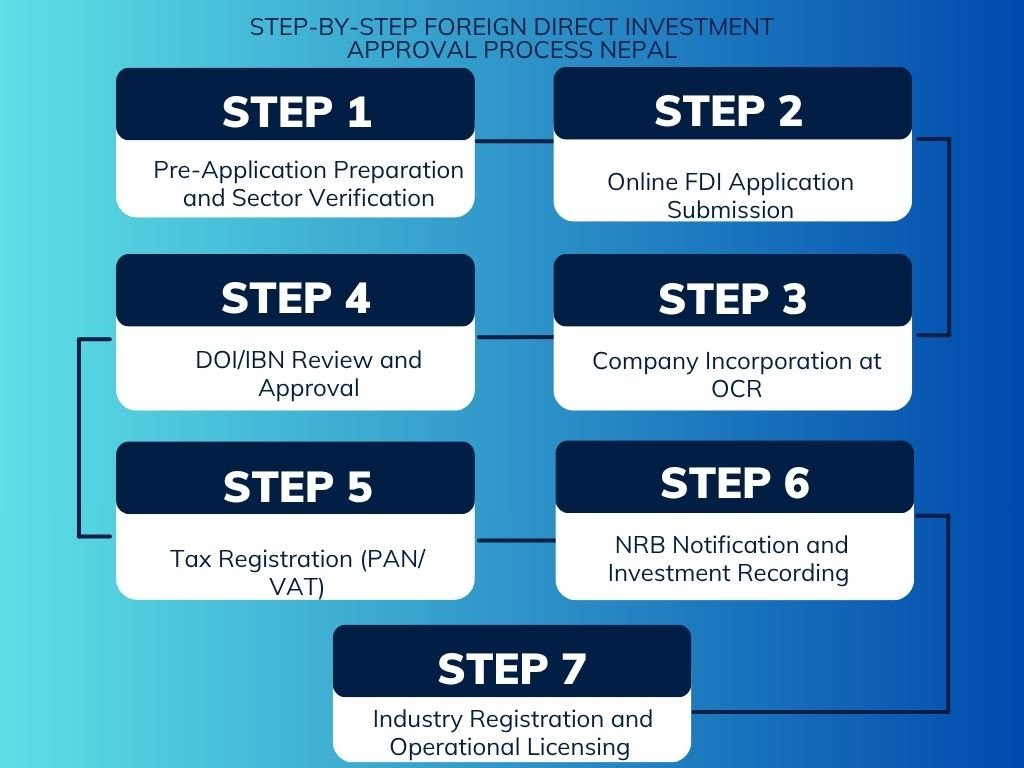
The foreign direct investment approval process Nepal follows a sequential structure. Each step must be completed before proceeding to the next.
Step 1: Pre-Application Preparation and Sector Verification
Before foreign direct investment approval process Nepal is initiated, thorough preparation is conducted:
- Business sector is verified against the negative list
- Investment size is determined to identify appropriate approval authority
- Automatic route eligibility is assessed
- Required documentation is compiled
- Local legal advisor engagement is completed
The negative list restricts FDI in primary agriculture, cottage industries, personal services, arms manufacturing, and real estate businesses. Proposed activities must be classified as "industries" under the Industrial Enterprises Act, 2076.
Step 2: Online FDI Application Submission
The formal foreign direct investment approval process Nepal begins with online application:
- Application is submitted through DOI Integrated Management Information System (IMIS) portal at imis.doind.gov.np
- Refundable guarantee deposit of NPR 20,000 is paid
- Project proposal with business plan is uploaded
- Investor profile and financial credibility documents are submitted
- Investment amount, sector details, and ownership structure are declared
The online system enables tracking and reduces processing delays associated with physical document submission.
Step 3: DOI/IBN Review and Approval
The application is reviewed by the competent authority:
- Eligibility under permitted sectors is verified
- Minimum investment thresholds are confirmed
- Compliance with FITTA and foreign exchange laws is assessed
- Additional information may be requested if documentation is incomplete
For automatic route applications, approval is granted within 7 working days if all documents are complete. Standard route approvals may require 15-30 working days for detailed evaluation.
Upon satisfaction, the authority issues an FDI Approval Letter specifying approved investment amount, permitted business activities, attached conditions, and timeline for company formation.
Step 4: Company Incorporation at OCR
Following FDI approval, company registration is completed:
- Company name is reserved through OCR online system
- Memorandum of Association (MOA) and Articles of Association (AOA) are drafted
- Incorporation application is submitted to Office of Company Registrar
- Registration fee is paid based on authorized capital
- Certificate of incorporation is issued within 7 working days
The company structure is typically a Private Limited Company, though Public Limited Companies may be formed for larger projects. Foreign investors may hold 100% ownership in most permitted sectors.
Step 5: Tax Registration (PAN/VAT)
Tax registrations are completed following incorporation:
- Permanent Account Number (PAN) is obtained from Inland Revenue Department
- Value Added Tax (VAT) registration is completed if annual turnover exceeds NPR 5 million
- Business registration is completed at local Ward Office
PAN registration is mandatory for all financial transactions, tax filing, and legal operations. The process is typically completed within 3 working days.
Step 6: NRB Notification and Investment Recording
Foreign exchange compliance is achieved through:
- Statutory notice is submitted to Nepal Rastra Bank before capital injection
- NRB acknowledgment letter is received within 3-4 working days
- Foreign currency account is opened at authorized commercial bank
- Investment is remitted through formal banking channels (SWIFT transfer)
- Inflow certificate is obtained from receiving bank
- Shareholder registry is updated at OCR
- Investment is recorded with NRB within 6 months of remittance
As of December 30, 2025, prior NRB approval is no longer required for foreign equity investments. NRB involvement is limited to post-inflow recording and supervision.
Step 7: Industry Registration and Operational Licensing
Final operational approvals are obtained:
- Industry registration is completed with Department of Industry
- Sector-specific licenses are secured from relevant authorities
- Environmental clearances are obtained if required
- Labor and Social Security registrations are completed
Industry registration is currently free (fees waived from FY 2080/81) and typically processed within 3-5 working days.
Timeline for Foreign Direct Investment Approval Process Nepal
The duration of foreign direct investment approval process Nepal varies depending on route and complexity.
| Phase | Estimated Duration | Factors Affecting Timeline |
|---|---|---|
| Pre-Application Preparation | 1-2 weeks | Document compilation, legal advisor engagement |
| FDI Approval (Automatic Route) | 7 working days | Complete documentation, no sector complications |
| FDI Approval (Standard Route) | 15-30 days | Additional scrutiny, inter-agency consultation |
| Company Incorporation | 5-7 days | Name availability, document preparation |
| Tax Registration | 2-3 days | Office address verification |
| NRB Notification | 3-4 days | Document completeness |
| Capital Injection & Recording | 2-4 weeks | Banking procedures, share registry update |
| Industry Registration | 3-5 days | Sector classification |
| Sector-Specific Licenses | 15-90 days | Industry complexity, regulatory requirements |
For automatic route investments, the complete foreign direct investment approval process Nepal is typically completed within 3-6 weeks. Complex projects requiring IBN approval or sectoral clearances may extend to 2-3 months.
Costs Associated with Foreign Direct Investment Approval Process Nepal
The cost of foreign direct investment approval process Nepal depends on investment size and complexity. The following cost components should be anticipated:
| Cost Category | Estimated Range (NPR) | Notes |
|---|---|---|
| Refundable Guarantee Deposit | 20,000 | Paid to DOI, refunded after compliance |
| Company Registration Fee | 15,000 - 30,000 | Based on authorized capital |
| Name Reservation | 500 | OCR online portal |
| Legal and Professional Fees | 50,000 - 200,000 | Varies by advisor and complexity |
| Document Notarization/Translation | 10,000 - 50,000 | Foreign documents require authentication |
| Industry Registration | Free | Fees waived from FY 2080/81 |
| PAN/VAT Registration | Free | No government fees |
| Sector-Specific License Fees | Variable | Depends on industry type |
| Bank Charges | 5,000 - 15,000 | Foreign currency transactions |
Minimum total professional fees for simple FDI projects range from NPR 100,000 to 300,000. Complex projects with multiple regulatory requirements may incur costs of NPR 500,000 or more.
Minimum Investment Requirements
The foreign direct investment approval process Nepal specifies minimum investment thresholds based on sector and route.
| Category | Minimum Investment | Approval Route |
|---|---|---|
| General Sectors | NPR 20 million (~USD 150,000) | Automatic or Standard |
| Information Technology | No minimum | Automatic route |
| Digital Industries | No minimum | Automatic route |
| Energy/Hydropower | NPR 20 million | Automatic (no upper limit) |
| Infrastructure | NPR 20 million | Automatic (no upper limit) |
| Tourism | NPR 20 million | Automatic (no upper limit) |
| Large Projects (NPR 6B) | NPR 20 million | IBN approval required |
The minimum threshold was reduced from NPR 50 million to NPR 20 million in 2022 to encourage smaller-scale foreign investment. IT sector exemption reflects Nepal's strategy to build technology industry.
Forms of Foreign Investment Recognized
Eight forms of investment are recognized under foreign direct investment approval process Nepal:
| Form | FITTA Section | Description |
|---|---|---|
| Equity Investment | Section 3 | Share capital in Nepal-incorporated company |
| Joint Venture | Section 4 | Partnership with existing Nepali industry |
| Asset/Share Purchase | Section 5 | Acquiring shares or assets of existing company |
| Lease Investment | Section 6 | Airlines, ships, machinery, construction equipment |
| Technology Transfer | Section 7 | IP licensing, franchising, management services |
| Branch Office | Section 8 | Foreign company establishing branch in Nepal |
| Venture Capital Fund | Sections 9-10 | Institutional investors via SEBON-registered fund |
| Reinvestment of Profits | Section 3 | Dividends reinvested in same industry |
Post-Approval Compliance Requirements
After foreign direct investment approval process Nepal is completed, ongoing compliance obligations must be fulfilled.
Annual Filing Requirements
- Annual return submission to OCR within 3 months of fiscal year-end
- Audited financial statements filing with tax authorities within 3 months
- Industry registration renewal annually with DOI
- Tax clearance certificate after annual tax assessment
Foreign Investment Reporting
- Quarterly reporting of foreign currency transactions to NRB
- Annual verification of foreign investment status with DOI
- Notification of changes in foreign shareholding pattern
- Reporting of technology transfer fee payments and royalty remittances
Corporate Governance Compliances
- Annual General Meeting within 6 months of fiscal year-end
- Statutory register maintenance including share register and minutes
- Director and address change updates with OCR
- CSR compliance (2% of annual profit for qualifying companies)
Capital Injection Schedule
Foreign investment must be injected according to prescribed timeline:
| Stage | Timeline | Injection Percentage |
|---|---|---|
| Stage I | Within 1 year of approval | 25% (up to NPR 20M), 15% (NPR 20M-250M), 10% (above NPR 250M) |
| Stage II | Upon commercial operation | Up to 70% total |
| Stage III | Within 2 years of operation | Remaining 30% |
Failure to meet capital injection timelines may result in revocation of FDI approval.
Repatriation of Investment and Profits
FITTA guarantees foreign investors the right to repatriate earnings subject to compliance.
Permitted Repatriation Categories
- Dividends and profits from business operations
- Capital gains from sale of shares or business interests
- Proceeds from complete business sale or liquidation
- Loan repayments and interest on foreign loans
- Technology transfer payments, royalties, and service fees
- Foreign employee remuneration after tax deduction
Repatriation Procedure
The repatriation process involves:
- DOI/IBN approval confirming FDI commitment fulfillment
- Tax clearance certificate from Inland Revenue Department
- Compliance with foreign exchange regulations
- Submission of audited financial statements
- Application to authorized commercial bank with documentation
- Bank approval within 15 days (as of December 2025)
NRB approval is now required only when repatriating to countries other than the original source country.
Sector-Specific Approval Requirements
Beyond standard foreign direct investment approval process Nepal, sector-specific approvals may be required.
| Sector | Regulatory Requirements |
|---|---|
| Banking and Financial Institutions | NRB preliminary approval, capital requirements, fit and proper assessment |
| Telecommunications | NTA technical evaluation, spectrum allocation, service-specific licensing |
| Hydropower | DoED survey license, Power Purchase Agreement, generation license |
| Tourism | Hotel classification, trekking/travel agency licensing |
| Healthcare | Ministry of Health approval, facility standards compliance |
| Education | Ministry of Education approval, curriculum certification |
| Insurance | Insurance Board approval, licensing requirements |
Frequently Asked Questions About Foreign Direct Investment Approval Process Nepal
What is the difference between automatic route and standard route?
The automatic route provides streamlined approval within 7 working days for designated sectors without upper investment limits. The standard route involves detailed scrutiny and discretionary approval for non-automatic route sectors or complex investments, typically requiring 15-30 days.
How long does FDI approval take in Nepal?
Automatic route approvals are completed within 7 working days. Standard route approvals take 15-30 days. The complete foreign direct investment approval process Nepal including company registration and NRB recording typically takes 3-6 weeks for automatic route investments.
Is NRB approval required before capital injection?
No. As of December 30, 2025, prior NRB approval is no longer required for foreign equity investments. Investors only need sectoral approval from DOI or IBN, with NRB involvement limited to post-inflow recording within 6 months.
What is the minimum investment for FDI in Nepal?
The minimum FDI is NPR 20 million (~USD 150,000) for most sectors. However, no minimum applies to IT and digital industry sectors under the automatic route. The threshold was reduced from NPR 50 million in 2022.
Can foreign investors own 100% of a Nepali company?
Yes, 100% foreign ownership is permitted in most sectors. Some sectors have ownership caps (e.g., ride-sharing 70%). Primary agriculture, cottage industries, and personal services are restricted from FDI entirely.
What documents are required for FDI approval?
Required documents include project report/business plan, investor passport/company registration, board resolution authorizing investment, financial credibility certificate, joint venture agreement (if applicable), power of attorney, and commitment letter for 1-year lock-in.
What is the One Stop Service Centre (OSSC)?
The OSSC centralizes government services for foreign investors at the Department of Industry in Kathmandu. It houses DOI's FITT Unit, OCR Unit, NRB Unit, and IRD services to reduce bureaucratic delays and processing time.
How is foreign investment recorded with NRB?
Investment must be recorded within 6 months of capital remittance by submitting inflow certificate from bank, shareholder registry from OCR, company documents, and investment details to NRB's Foreign Exchange Management Department. Recording takes 15-20 working days.
Can profits be repatriated freely from Nepal?
Yes, profit repatriation is guaranteed under FITTA. After tax clearance, commercial banks approve repatriation within 15 days. NRB approval is only needed if repatriating to countries other than the source country.
What happens if FDI approval conditions are not met?
Failure to meet capital injection schedules, compliance requirements, or approval conditions may result in penalties, restrictions on repatriation rights, or revocation of FDI approval and business licenses.
Conclusion: Successfully Navigating Foreign Direct Investment Approval Process Nepal
Foreign direct investment approval process Nepal requires careful planning, thorough documentation, and strict compliance with legal procedures. Whether automatic route or standard approval is pursued, proper execution ensures regulatory compliance and investment protection.
Recent reforms including removal of NPR 500 million ceiling for automatic route, elimination of minimum investment for IT sectors, and delegation of repatriation approval to commercial banks have significantly improved Nepal's investment climate. The February 2026 notification expanding automatic route to 102 sectors represents continued liberalization.
For expert assistance with foreign direct investment approval process Nepal, professional legal guidance is recommended. Corporate Np provides comprehensive FDI services, including approval application, company registration, compliance management, and ongoing regulatory support. Contact Corporate Np today for a confidential consultation on your foreign investment requirements.
Disclaimer: This blog is provided for informational purposes only and does not constitute legal advice. The information presented herein is based on FITTA, 2075, Companies Act, 2063, and related legislation as of the publication date. Laws and procedures may change, and specific circumstances may require tailored legal advice. Always consult with a qualified legal professional before making decisions regarding foreign direct investment approval process Nepal.
References
For further information on foreign direct investment approval process Nepal, the following authoritative resources are recommended:
- Office of Company Registrar Nepal - Company registration and incorporation
- Department of Industry Nepal - FDI approval and industry registration
- Investment Board Nepal - Large-scale investment approval
- Nepal Rastra Bank - Foreign exchange and investment recording
- Inland Revenue Department Nepal - Tax registration and compliance
- Ministry of Industry Commerce and Supplies - FDI policy and regulations
- Nepal Law Commission - FITTA and Companies Act legislation
- Securities Board of Nepal - Listed company regulations