


On this page
Basics of Branch Office Registration in Nepal

A foreign company that wants to do business in Nepal without forming a new Nepali company can apply to open a branch office. This article explains the legal basis, eligibility, steps, documents, timeline, cost, tax and compliance rules. Branch offices are permitted only in limited cases, so the legal route should be confirmed before any application is filed.
Note: Fees, thresholds and procedures change often through Finance Acts, Directives and Regulations. Verify them with the relevant authority before filing.
What Is a Branch Office in Nepal?
A branch office is an extension of a foreign parent company. It is not a separate legal entity. The parent company is directly responsible for its acts, debts and liabilities in Nepal.
A foreign company can establish a branch office in Nepal only with prior government approval and only for permitted activities. The right route depends on the sector and the business model.
Branch Office vs. Liaison Office vs. Representative Office vs. Subsidiary
| Feature | Branch Office | Liaison / Representative Office | Subsidiary Company |
|---|---|---|---|
| Legal status | Extension of the foreign company | Extension of the foreign company | Separate Nepali company |
| Income earning | Allowed only if approved | Generally not allowed | Allowed |
| Main role | Carries out approved business | Coordination, promotion, information | Full business operations |
| Liability of parent | Direct | Direct | Limited to share capital |
| Registration | Approval, then company registration | Approval from the concerned authority | Company registration, FITTA approval |
Legal Framework Governing Branch Offices
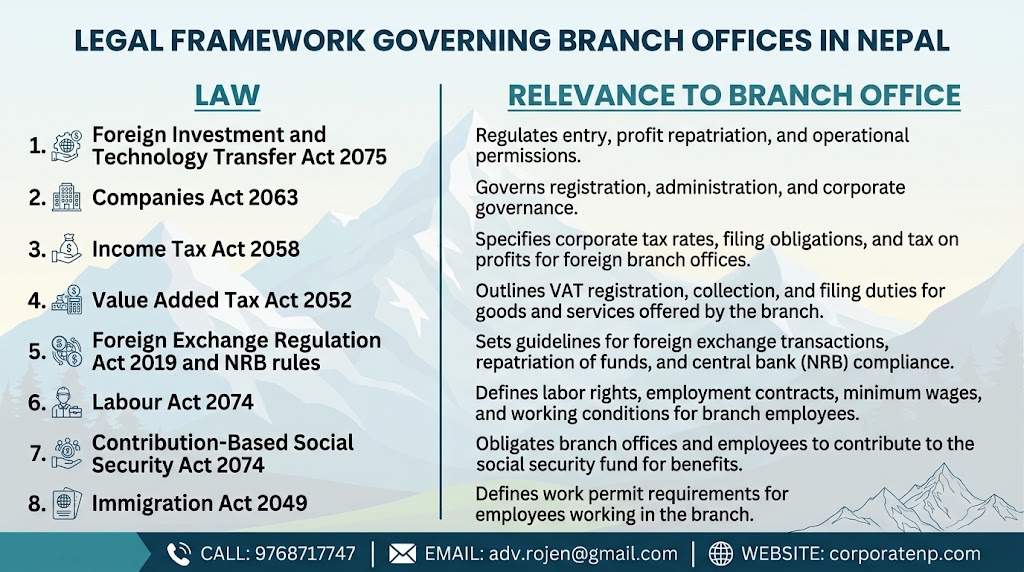
| Law | Relevance |
|---|---|
| Foreign Investment and Technology Transfer Act, 2075 (2019) and its Regulation | Approval of foreign investment and the negative list of sectors |
| Companies Act, 2063 (2006) | Provisions on registration of foreign companies |
| Income Tax Act, 2058 (2002) | Tax on branches (permanent establishments) of non-residents |
| Value Added Tax Act, 2052 (1996) | VAT registration and compliance |
| Foreign Exchange (Regulation) Act, 2019 (1962) and Nepal Rastra Bank (NRB) rules | Remittance and foreign exchange |
| Labour Act, 2074 (2017) | Employment of staff |
| Contribution-Based Social Security Act, 2074 | Social security contributions |
| Immigration Act, 2049 (1992) and rules | Visas for foreign staff |
Sector laws also apply. Examples are the Banks and Financial Institutions Act, 2073, the Insurance Act, 2079 and the Civil Aviation Authority Act, 2053.
Eligibility for Branch Office Registration
Who Can Apply?
- A foreign company that is lawfully incorporated in its home country and in good standing.
- A company whose proposed activity is allowed for foreign investors.
- A company whose activity is not on the negative list of the Foreign Investment and Technology Transfer Act, 2075.
- A company that appoints a representative in Nepal.
Key Eligibility Points
| Requirement | Explanation |
|---|---|
| Valid parent company | Existing and lawfully registered abroad |
| Permitted activity | Must not fall within the FITTA negative list |
| Prior approval | From the Department of Industry or the sector regulator |
| Nepal representative | Authorized by Power of Attorney |
| Physical address | A proposed office address in Nepal |
Restricted Sectors
Foreign investment is restricted in certain sectors, so the negative list under FITTA must be checked. Commonly cited examples include:
- Personal service businesses such as barber shops, beauty parlours and tailoring
- Retail business
- Arms, ammunition and explosives
- Atomic energy and radioactive materials
- Real estate business (construction is treated differently)
- Security printing, and currency and coin
- Certain tourism activities such as trekking guiding and rafting
Regulators That May Be Involved
| Authority | Role |
|---|---|
| Department of Industry (DOI) | Approval under FITTA |
| Office of the Company Registrar (OCR) | Registration of the foreign company's office |
| Inland Revenue Office / Large Taxpayer Office | PAN and VAT registration |
| Nepal Rastra Bank (NRB) | Foreign exchange and remittance |
| Sector regulators | Banking, insurance, aviation, telecom and others |
| Department of Labour / Social Security Fund | Staff and contributions |
Steps for Branch Office Registration in Nepal
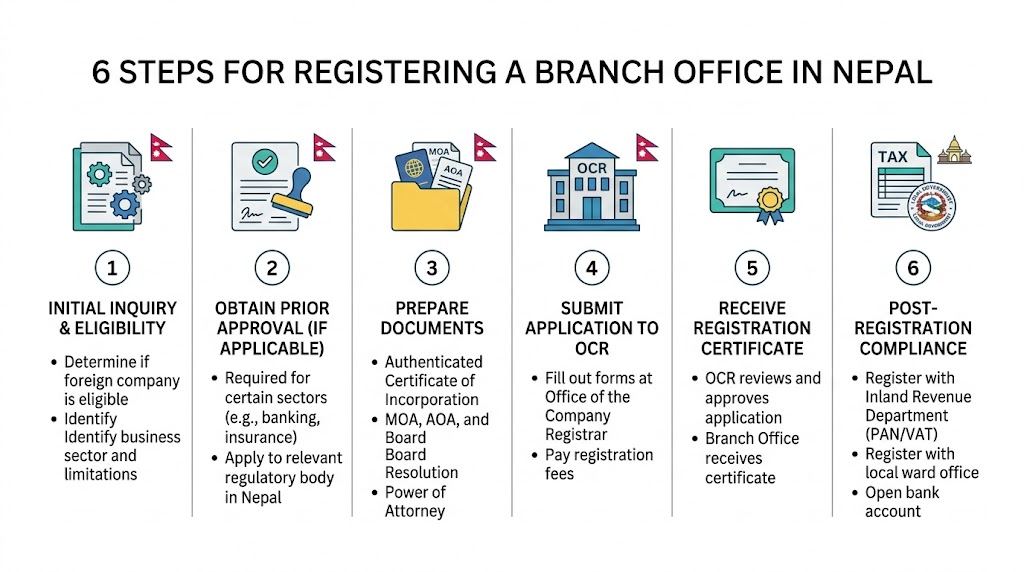
- Step 1: Check eligibility and the legal route
- Step 2: Obtain prior approval from the relevant authority
- Step 3: Prepare, notarize and authenticate the foreign company documents
- Step 4: Apply for registration of the branch office
- Step 5: Obtain PAN/VAT registration
- Step 6: Complete post-registration compliance (bank account, permits, staff, reporting)
How to Register a Branch Office in Nepal
Step 1: Check Eligibility and the Legal Route
First confirm that the business activity is open to foreign investors. Also confirm whether the activity needs approval from a sector regulator. Foreign investment approval and company registration are separate processes, and many applications fail because the wrong route is chosen.
Step 2: Obtain Prior Approval
Apply to the relevant authority. This is usually the Department of Industry under FITTA, or a sector regulator. Typical contents of the application:
- Details of the parent company
- Nature and scope of the business in Nepal
- Proposed funding (remittance of funds from abroad)
- Board resolution and Power of Attorney
Step 3: Prepare and Notarize Foreign Documents
The documents must be notarized in the home country. They must also be authenticated by the Nepali Embassy or Consulate, or apostilled where applicable. Documents in languages other than Nepali or English need an official translation.
Step 4: Apply for Registration
After approval, apply to the Office of the Company Registrar for registration of the foreign company's office under the Companies Act, 2063. Submit the approval letter, the constitutional documents, the representative's details and the office address. The registration certificate is issued after review.
Step 5: Obtain PAN/VAT Registration
Register with the Inland Revenue Office for a Permanent Account Number (PAN). Register for VAT if the business is VATable. The threshold under the VAT Act, 2052 is generally Rs. 5 million annual turnover for goods and Rs. 2 million for services, as updated by Finance Acts.
Step 6: Complete Post-Registration Compliance
- Open a bank account in Nepal
- Obtain a local municipality business registration or license where required
- Register employees with the Social Security Fund
- Obtain sector licenses
- Bring in foreign funds through banking channels and keep the records for remittance purposes
Documents Required
| Document | Requirement |
|---|---|
| Certificate of Incorporation | Notarized and authenticated copy |
| Memorandum and Articles of Association (or equivalent) | Notarized and authenticated copy |
| Board resolution | Approving the branch and appointing a representative |
| Audited financial statements | Recent years, to show financial standing |
| Directors' details | Names, nationalities, addresses |
| Power of Attorney | In favour of the Nepal representative |
| Proposed office address | Rent agreement or ownership proof |
| Business description | Scope of activities in Nepal |
| Application forms | As prescribed by the authority |
| Passport/ID copies | Of the representative and directors |
| Translation | Official translation if not in Nepali or English |
Tip: Missing authentication or inconsistent names across documents are the most common reasons for rejection.
Registration Timeline
The following are indicative periods. Actual times depend on the authority and the completeness of the file.
| Stage | Estimated Time |
|---|---|
| Document preparation and authentication (abroad) | 1–3 weeks |
| Approval from the relevant authority | 2–6 weeks |
| Company registration | 1–2 weeks |
| PAN/VAT registration | 1–7 days |
| Bank account and other formalities | 1–3 weeks |
Total time is usually about 6 to 12 weeks.
Factors That May Delay Registration
- Improper authentication or translation
- Unclear business scope
- Delays by sector regulators
- Queries from the authority that are not answered promptly
- Holidays and administrative backlog
Legal Due Diligence
Careful due diligence reduces rejection risk. Our review covers:
- Parent company status: Check that the company is validly incorporated and in good standing.
- Business activity: Check the negative list and sector rules.
- Approval route: Identify whether DOI, NRB or another regulator has jurisdiction.
- Tax and licensing: Check PAN/VAT, income tax, municipal and sector licences.
- Foreign exchange: Check NRB rules on inward and outward remittance.
- Representative: Verify the Power of Attorney, its scope and the representative's authority.
Preparation of Documents
Key documents prepared for the application:
| Document | Key Points |
|---|---|
| Board resolution | Decision to set up the branch, nature of activity, appointment of representative |
| Application forms | As prescribed by the relevant authority |
| Power of Attorney | Defines the powers to sign, file, open bank accounts and represent the company |
| Operational details | Business plan, funding, staff and office details |
| Authentication | Notarization and consular legalization or apostille |
| Translation | Certified translation where needed |
| Declarations and undertakings | Where required by the authority |
Approval and Registration Process
- Submission: The application and supporting documents are filed with the authority.
- Review: The authority examines eligibility, documents and the proposed activity.
- Queries: The authority may ask for clarifications or additional documents. Quick responses prevent delay.
- Approval or registration certificate: Issued once all conditions are met.
- Tax and operational registrations: PAN/VAT, bank account, municipal registration, social security and licences.
Cost of Branch Office Registration in Nepal
Note: Actual costs depend on the type of company, the authority, the fee schedule at the time of filing and the scope of services.
A. Government Fees
| Item | Details |
|---|---|
| Application / approval fee | As per the relevant authority's fee schedule |
| Company registration fee | As per the OCR fee schedule |
| PAN / VAT registration | Generally no or nominal fee |
| Municipal or sector licence fees | Depend on the activity and location |
B. Professional Service Fees
| Item | Details |
|---|---|
| Legal consultation | Eligibility and route assessment |
| Drafting and review | Resolution, Power of Attorney, forms |
| Notarization, authentication, translation | Charged by notaries, embassies and translators |
| Filing and follow-up | Representation before authorities |
C. Other Expenses
- Office rent and deposits
- Costs of appointing a representative
- Accounting, audit and tax compliance costs
- Staff recruitment and social security contributions
Taxation and Compliance Requirements
| Area | Requirement |
|---|---|
| PAN | Required for all branches |
| VAT | Registration required above the threshold. The standard rate is 13%. |
| Income tax | A branch of a non-resident is taxed under the Income Tax Act, 2058. The general corporate rate is 25%, and certain sectors have higher rates. |
| Repatriation tax | Tax is levied on profit repatriated from the branch to the parent. Check the current rate under the Income Tax Act and applicable treaty. |
| Withholding tax (TDS) | Applies to salary, rent, service payments and similar items |
| Accounting | Books maintained in Nepal, with audit by a registered auditor |
| Tax returns | Annual return is generally due within three months of the end of the fiscal year (fiscal year ends mid-July) |
| VAT returns | Monthly filing |
| Foreign exchange | Inward funds and remittance must follow FITTA and NRB rules, using banking channels |
| Renewals | Annual renewal or reporting as required by the authority or the sector regulator |
Nepal has double taxation avoidance agreements with some countries. Their application should be checked individually.
Branch Office vs. Subsidiary Company in Nepal
| Factor | Branch Office | Subsidiary Company |
|---|---|---|
| Legal status | Part of the foreign company | Separate Nepali company under the Companies Act, 2063 |
| Ownership and control | Fully controlled by the parent | Controlled through shareholding |
| Business activities | Limited to approved activities | Broader, subject to the negative list |
| Liability | Parent is directly liable | Limited to share capital |
| Tax treatment | Taxed as a non-resident's permanent establishment, with repatriation tax | Taxed as a resident company; dividends taxed separately |
| Registration process | Approval, then registration | FITTA approval, then company registration |
| Cost | Usually lower setup cost | Usually higher, because of minimum capital rules |
| Suitability | Service and project-based operations, sector-specific entry | Long-term commercial operations and local investment |
Foreign investment in Nepal under FITTA generally requires a minimum investment of Rs. 20 million. A subsidiary is usually the practical choice for general commercial operations.
Common Challenges
- Improper documents: Missing notarization, authentication or translation.
- Approval delays: Slow processing or repeated queries.
- Unclear business scope: The description does not match a permitted activity.
- Tax and foreign exchange issues: Poor record-keeping and incorrect remittance.
- Wrong structure: Choosing a branch when a subsidiary or liaison office is the legally available route.
Why Choose Us?
Corporate Np is the best and No. 1 service provider in Nepal for branch office registration. Our services include:
- Eligibility and structure assessment
- Legal due diligence
- Drafting of resolutions, Power of Attorney and applications
- Coordination with the Department of Industry, Office of the Company Registrar, Inland Revenue Office and NRB
- PAN/VAT registration
- Ongoing tax, legal and compliance support
Conclusion
A branch office in Nepal needs prior approval, proper documents, registration with the Office of the Company Registrar, tax registration and continuing compliance. The key is to identify the correct legal route before filing, because the wrong choice leads to rejection, cost and delay.
Contact Corporate Np, the No. 1 Business Consultant in Nepal for branch office registration, for expert help with eligibility assessment, document preparation, registration, tax registration and ongoing compliance.
Frequently Asked Questions
Can a foreign company open a branch office in Nepal?
Yes, but only in permitted cases and with prior government approval. The route depends on the sector and the activity
Which authority registers a foreign company's branch office?
Approval is generally obtained from the Department of Industry or a sector regulator. The Office of the Company Registrar then registers the foreign company's office under the Companies Act, 2063.
How long does branch office registration take?
Generally 6 to 12 weeks, depending on approval time and the completeness of documents.
What documents are required?
The certificate of incorporation, constitutional documents, board resolution, audited financials, Power of Attorney, office address, business description and application forms. All foreign documents must be authenticated
How much does registration cost?
It depends on government fee schedules, the sector and professional fees. Contact us for a customized estimate.
Can a branch office generate revenue in Nepal?
Only if the approval allows it. A liaison or representative office generally cannot earn income in Nepal.
Is foreign investment approval required?
Generally yes. Where foreign capital is brought in, approval under the Foreign Investment and Technology Transfer Act, 2075 is the usual route
Does a branch office need PAN or VAT?
PAN is required. VAT registration is required if the business is VATable or crosses the threshold set by the VAT Act, 2052.
Can a branch office hire employees?
Yes. It must follow the Labour Act, 2074 and the Contribution-Based Social Security Act, 2074. Foreign staff need appropriate visas and work permission.
What is the difference between a branch and a subsidiary?
A branch is part of the foreign company, so the parent is directly liable. A subsidiary is a separate Nepali company with limited liability.
Can a branch remit profits to its foreign parent?
Yes, after paying taxes and following FITTA and NRB rules. Repatriation tax applies, and proper banking records and tax clearance are needed.
Can a branch own land or property in Nepal?
Foreign entities face restrictions under Nepali land laws. A branch generally leases premises rather than owning land. Check the current Land Act and FITTA provisions.
Does the foreign company's name change in Nepal?
The branch generally operates under the parent's name. The authority must be told of any variation.
Do all documents need Nepali translation?
Documents in a language other than Nepali or English generally need an official translation.
What happens if the approval conditions are violated?
The authority may impose penalties or cancel the approval and registration. Under FITTA, non-compliance can bring fines and other legal consequences.