
- adv.rojen@gmail.com
- Anamnagar Kathmandu

Real Estate License in Nepal

25
Mar
Table of Contents
A real estate license in Nepal is now a legal requirement, not an option. After years of operating in a loosely regulated environment, Nepal's property sector entered a new era in 2024 and 2025, when the Land Revenue Act 2034 was amended to mandate licensing for real estate transactions and the Land Revenue Rules were amended to make that mandate operational. Today, any natural person or company that assists, consults, or facilitates the purchase or sale of houses or land as a business must hold a license issued by the designated authority under the Ministry of Land Management. Transactions completed without one expose the operator to fines equal to the transaction amount and even imprisonment.
This guide explains the real estate license in Nepal in complete and practical detail. It covers the new legal framework under Section 26A and Section 26B of the Land Revenue Act, the fee and renewal schedule under the Eighth Amendment to the Land Revenue Rules, the mandatory geo-information system requirement, the full application process, eligibility conditions, document requirements, penalties for unlicensed operation, and the compliance duties that follow every license holder. Everything is written for real estate companies, brokers, consultants, and developers who need to regularize their status before enforcement tightens further.
What Is a Real Estate License in Nepal and Why Did It Become Mandatory?
Legal Definition of the Real Estate License
Under the new framework, a real estate license in Nepal is the official authorization granted to a natural or legal person to engage in real estate transactions as a business. The license is issued under Section 26A of the Land Revenue Act 2034, which was inserted by the Twelfth Amendment to the Act on 2080 Chaitra 30 (April 12, 2024). The detailed procedure was then activated by the Eighth Amendment to the Land Revenue Rules, published in the Nepal Gazette on 2082 Bhadra 12 (August 2025), which prescribed the application format, fee structure, renewal procedure, and operational conditions.
Why the Government Imposed Mandatory Licensing
The licensing mandate was driven by three policy goals. First, transparency: the property market had long operated through informal brokers with no accountability mechanism, leaving buyers and sellers exposed to fraud, double sales, and manipulated valuations. Second, revenue protection: unregistered intermediaries moved high-value transactions outside the tax net. Third, anti-money laundering: land and housing are classic vehicles for parking illicit funds, and the government has aligned the licensing system with its broader financial integrity agenda.
Who Needs a License and Who Does Not
The real estate license in Nepal applies to anyone who assists any person in the purchase or sale of a house or land, whether for remuneration or not, and to anyone who provides consultation or related professional services in such transactions. This covers brokerage firms, real estate companies, property consultancies, and developers selling their own projects through intermediaries. The law expressly does not apply to transactions mutually agreed between natural persons for their own purposes. A person selling their own house to a buyer they found themselves, without a facilitator, does not need a license.
Legal Framework for the Real Estate License in Nepal
The Statutes and Provisions
The real estate license in Nepal is governed by a compact but demanding set of provisions. Section 26A of the Land Revenue Act 2034 creates the licensing requirement. Section 26B authorizes the Government of Nepal to designate the licensing authority and empowers it to issue, renew, and cancel licenses. In the Land Revenue Rules, Rule 23J prescribes the application procedure in Schedule 8 format, Rule 23K prescribes the fees and renewal mechanics with the license format in Schedule 9, and Rule 23A mandates transaction processing through the geo-information system.
| Provision | Subject |
|---|---|
| Land Revenue Act 2034, Section 26A | Mandatory license for real estate transactions |
| Land Revenue Act 2034, Section 26B | Licensing authority, issuance, and cancellation |
| Land Revenue Rules, Rule 23J | Application procedure and format |
| Land Revenue Rules, Rule 23K | Fees, renewal, and late renewal |
| Land Revenue Rules, Rule 23A | Mandatory GIS and Land Service Center use |
| Real Estate Business (Regulation) Act 2076 | Broader real estate business regulation |
The Licensing Authority
Under Section 26B(1), the Government of Nepal designates the authority responsible for receiving and deciding license applications. The system operates under the Ministry of Land Management, Cooperatives and Poverty Alleviation, through the Department of Land Management and Archives and the land revenue offices in the field. The authority conducts a necessary inquiry into each application and, if satisfied with the applicant's qualifications and financial credibility, grants the license.
Real Estate License Fees in Nepal
The Two-Slab Fee Structure
The fee for a real estate license in Nepal is set by Rule 23K and is divided into two slabs based on the maximum value of a single transaction the licensee will handle.
| License Category | Maximum Single Transaction | License Fee |
|---|---|---|
| Category A | Up to NPR 50 million | NPR 500,000 |
| Category B | Exceeding NPR 50 million | NPR 1,000,000 |
The distinction is deliberate. An operator who intends to broker apartments and mid-value plots can enter at the lower slab, while firms handling commercial buildings, large land parcels, and premium developments must pay the higher fee. The declared maximum transaction value becomes a condition of the license, and exceeding it places the licensee in violation.

Renewal Fees and the Late Renewal Window
A real estate license in Nepal must be renewed periodically, and the standard license term is five years. Renewal must be applied for at least thirty-five days before expiry. The renewal fees are NPR 400,000 for Category A licensees and NPR 800,000 for Category B licensees. Where the renewal window is missed, the law provides a grace mechanism: the license may still be renewed within ninety days of expiry upon payment of the renewal fee plus an additional NPR 50,000 late fee. Beyond that window, the license lapses and fresh application becomes necessary.
How to Apply for a Real Estate License in Nepal: Step-by-Step Process
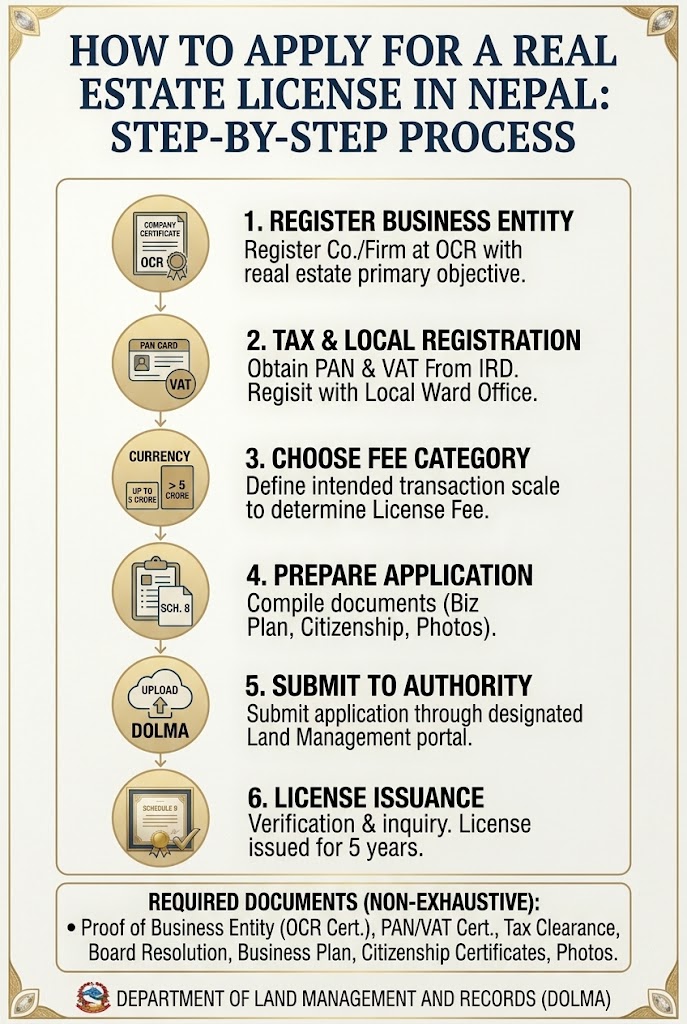
Stage One: Establish the Business Foundation
The real estate license in Nepal is applied for by a natural or legal person, and in practice nearly all applicants are companies. The company must first be registered at the Office of the Company Registrar with real estate objectives in its Memorandum of Association, obtain its PAN from the Inland Revenue Department, register with the local ward office, and hold a tax clearance certificate. An existing company that was registered for other purposes must amend its objectives before applying.
Stage Two: Prepare the Application File
The application is submitted in the Schedule 8 format prescribed under Rule 23J, together with the supporting documents. The file must demonstrate the applicant's qualifications, financial credibility, and operational readiness, including the declared maximum single-transaction value that determines the fee slab.
Stage Three: Authority Inquiry and Decision
The designated authority conducts a necessary inquiry into the application. This inquiry examines the company's registration, tax standing, financial capacity, and the genuineness of its intended operations. If satisfied, the authority grants the license in the Schedule 9 format.
Stage Four: GIS Integration and Operational Setup
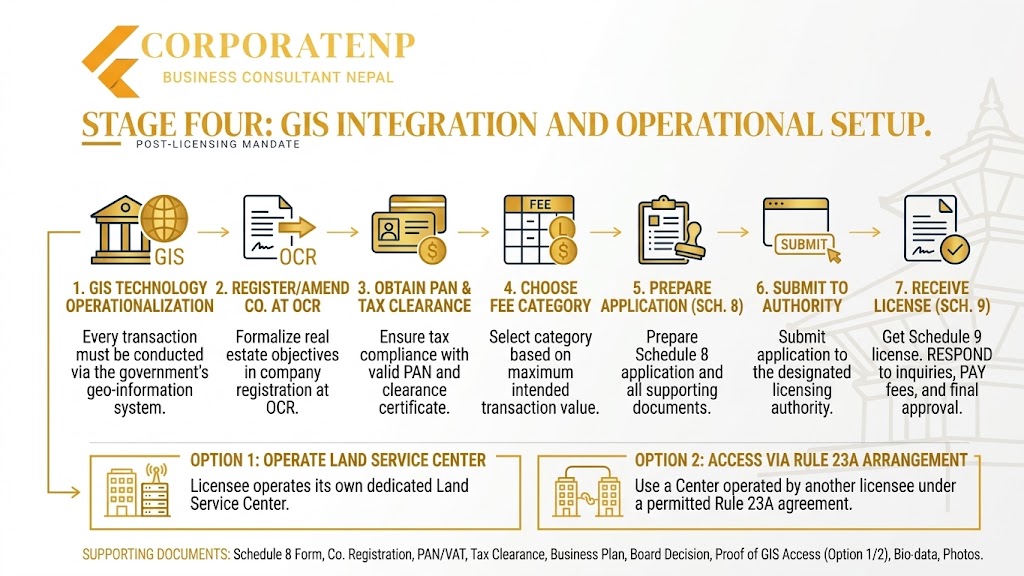
Upon receiving the license, the holder must operationalize the mandatory technology requirement. Every licensee must conduct transactions through the government's geo-information system, either by operating its own Land Service Center or by using a Land Service Center operated by another licensee under the arrangement permitted by Rule 23A.
- Register or amend the company at the OCR with real estate objectives.
- Obtain PAN and maintain tax clearance.
- Complete ward office registration.
- Choose the fee category based on maximum transaction value.
- Prepare the Schedule 8 application and supporting documents.
- Submit the application to the designated licensing authority.
- Respond to inquiry and provide any additional evidence requested.
- Pay the license fee upon approval.
- Receive the Schedule 9 license certificate.
- Set up or arrange access to a GIS-based Land Service Center.
Documents Required for a Real Estate License in Nepal
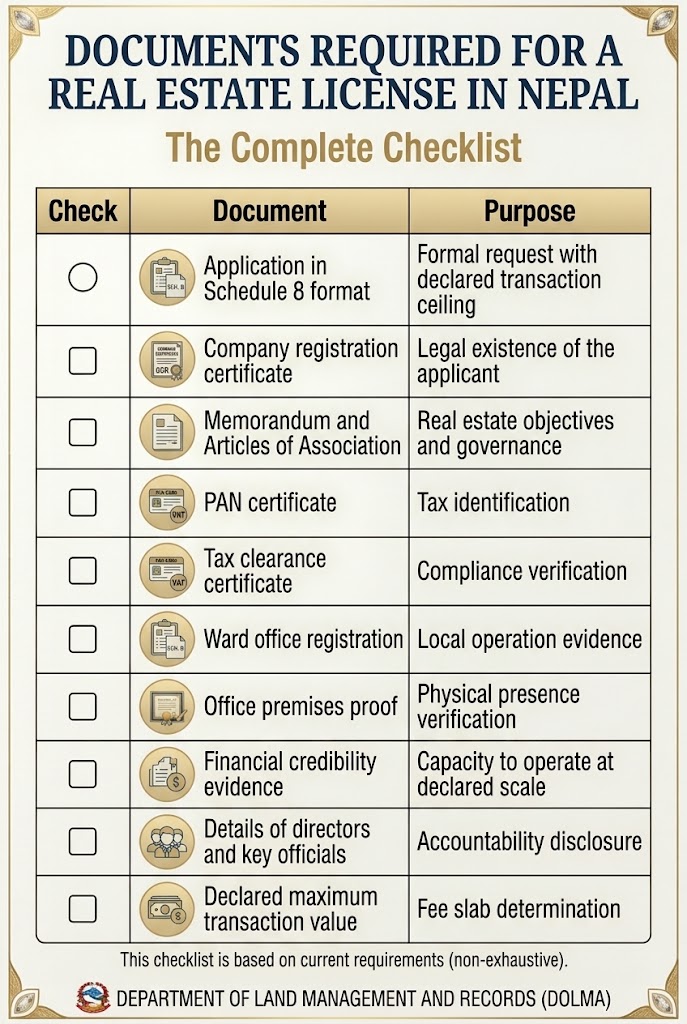
The Complete Checklist
| Document | Purpose |
|---|---|
| Application in Schedule 8 format | Formal request with declared transaction ceiling |
| Company registration certificate | Legal existence of the applicant |
| Memorandum and Articles of Association | Real estate objectives and governance |
| PAN certificate | Tax identification |
| Tax clearance certificate | Compliance verification |
| Ward office registration | Local operation evidence |
| Office premises proof | Physical presence verification |
| Financial credibility evidence | Capacity to operate at declared scale |
| Details of directors and key officials | Accountability disclosure |
| Declared maximum transaction value | Fee slab determination |
Since the regime is new, the designated authority may request additional documents during its inquiry, and applicants should respond within the time allowed to keep the file alive.
Mandatory Duties of a Real Estate License Holder in Nepal
The Operating Conditions Attached to the License
The real estate license in Nepal carries continuing duties that define lawful operation. First, all transactions must be conducted exclusively through the Land Information System, either at the holder's own Land Service Center or through another licensee's center. Second, no false information, maps, values, or ownership details may be presented in any transaction. Third, the license must be clearly displayed at the office or business location. Fourth, complete records of all transactions must be maintained, and a report must be submitted to the concerned department within three months after the end of each financial year. Fifth, during inspections or supervision, the license holder or an authorized person must provide all information requested by the inspecting officer.
The Land Service Center Opportunity
A license holder who meets the prescribed qualifications is eligible to operate a Land Service Center, which can provide a range of public-facing land administration services including online application submission, document verification and dispatch, land information system entry, printing of forms and applications, and general land administration information. The Land Service Center model converts the compliance burden into a business opportunity, because centers earn service revenue from the public while satisfying the licensee's own GIS obligation.
Penalties for Operating Without a Real Estate License in Nepal
The Penalty Structure
Enforcement under the new framework is severe by design. A person who conducts house or land transactions without a license faces a penalty equal to the amount of the transaction where the transaction amount is disclosed, and a fine of up to NPR 2.5 million where it is not disclosed, with imprisonment of up to six months or both in either case. For a licensed operator who violates the Act, the Rules, or the conditions of the license, the authority may impose a penalty equal to the transaction amount where disclosed and a fine of up to NPR 1 million where not disclosed.
| Violation | Penalty |
|---|---|
| Unlicensed transaction, amount disclosed | Fine equal to transaction amount, possible imprisonment |
| Unlicensed transaction, amount not disclosed | Fine up to NPR 2.5 million, possible imprisonment |
| License condition violation, amount disclosed | Fine up to transaction amount |
| License condition violation, amount not disclosed | Fine up to NPR 1 million |
| False information in application | License cancellation |
| Fraudulent or misused license | License cancellation |
Cancellation Grounds
The license may be cancelled where false details were provided in the application, where the license was obtained fraudulently or is being misused, or where the holder violates the Act, the Rules, or the directions of the authority and fails to remedy the situation. Cancellation is published and effectively ends the holder's ability to operate, because unlicensed operation after cancellation attracts the full penalty structure.
Real Estate License in Nepal: Status and Market Reality
Early Adoption Numbers
The licensing system is young, and adoption is still building. By the first year of implementation, only a limited number of companies, reported in the dozens, had obtained licenses, even though the market contains thousands of active brokers and consultancies. This gap between the licensed and the unlicensed creates both risk and opportunity. Risk, because enforcement will eventually close in on unlicensed operators. Opportunity, because licensed firms face dramatically reduced competition in the formal market and can position themselves as the trustworthy channel for banks, developers, and institutional sellers.
Relationship with the Older Broker Licensing Regime
The new license under Section 26A operates alongside the older framework of the Real Estate Business (Regulation) Act 2076, under which broker and developer licenses have been issued through district land revenue offices with their own capital and office requirements. In practice, a serious operator should map both regimes with counsel and satisfy the one that governs its actual activity, because the authorities share information and a gap in either regime is a gap in compliance.
Common Mistakes in Applying for a Real Estate License in Nepal
Frequent Errors Seen in Practice
| Mistake | Consequence |
|---|---|
| Declaring too low a transaction ceiling | Fee saving now, violation later |
| Operating while the application is pending | Treated as unlicensed operation |
| No tax clearance at application | File rejected at intake |
| Missing the 35-day renewal window | NPR 50,000 late fee and stress |
| Ignoring the GIS requirement | License conditions breached |
| No transaction records maintained | Annual report impossible, inspection failure |
| Using the license for an excluded personal deal | Confusion and potential misuse finding |
Frequently Asked Questions About Real Estate License in Nepal
What is a real estate license in Nepal?
A real estate license in Nepal is the mandatory authorization under Section 26A of the Land Revenue Act 2034 for any person or company engaged in assisting, consulting on, or facilitating the purchase or sale of houses or land as a business.
When did the real estate license become mandatory?
The mandate was created by the Twelfth Amendment to the Land Revenue Act on April 12, 2024, and its operational details were activated by the Eighth Amendment to the Land Revenue Rules published in the Gazette in August 2025.
How much does a real estate license cost in Nepal?
NPR 500,000 for licensees handling transactions up to NPR 50 million at a time, and NPR 1,000,000 for licensees handling larger transactions.
How long is the license valid?
The license is issued for a term of up to five years, subject to renewal and continued compliance.
What is the renewal fee and deadline?
Renewal fees are NPR 400,000 and NPR 800,000 by category, applied for at least thirty-five days before expiry, with a ninety-day late renewal window carrying an additional NPR 50,000.
Do private individuals selling their own property need a license?
No. Transactions mutually agreed between natural persons for their own purposes are excluded from the licensing requirement.
What is the penalty for operating without a license?
A fine equal to the transaction amount where disclosed, or up to NPR 2.5 million where not disclosed, with imprisonment of up to six months or both.
Is technology use mandatory under the license?
Yes. All licensed transactions must be processed through the government's geo-information system via a Land Service Center, either the holder's own or another licensee's.
Can the license be transferred or sold?
No. Licenses are personal to the holder and non-transferable, and significant ownership changes require a fresh application.
What happens if false information is given in the application?
The license may be cancelled, and the holder becomes liable for penalties and prosecution.
Can foreigners obtain a real estate license in Nepal?
Real estate brokerage by foreign-controlled entities is restricted under the foreign investment regime, and structuring advice should be taken before any foreign participation is planned.
What records must a license holder maintain?
Complete transaction records, submitted in an annual report to the concerned department within three months after each financial year.
Conclusion and Call to Action
The real estate license in Nepal has ended the era of informal brokerage. The legal framework is now clear: license, fee, renewal, technology, records, and severe penalties for the unlicensed. Firms that obtain their licenses early gain a defensible market position, access to the Land Service Center revenue model, and credibility with banks, developers, and institutional clients. Firms that wait expose themselves to penalties that can equal an entire transaction's value.
If your company is engaged in property brokerage, consultancy, or development sales, the time to regularize is now. CorporateNP Pvt. Ltd. provides complete real estate licensing support, including company registration and objective amendments, PAN and tax clearance coordination, Schedule 8 application preparation, authority liaison, GIS and Land Service Center setup guidance, and annual compliance management. Contact our team today for a confidential consultation, and put your real estate business on the licensed side of Nepal's new property law.
References
For verification and further reading, the following sources are recommended:
- Ministry of Land Management, Cooperatives and Poverty Alleviation – Official Website
- Department of Land Management and Archives
Disclaimer: This article is provided for general informational purposes only and does not constitute legal advice. Licensing requirements, fees, and procedures in Nepal are revised periodically through amendments to the Land Revenue Act and Rules. Readers are advised to confirm current requirements with the designated licensing authority or consult a licensed attorney before taking action.